Report on the causes of persistent low dissolved oxygen in Shark Creek
Shark Creek is a tidal channel on the Clarence River estuary floodplain that dissects an acid sulfate soil (ASS) backswamp wetland.
This investigation explores why dissolved oxygen (DO) in Shark Creek remains chronically and severely depleted — well below levels safe for aquatic life — even during dry conditions when active acid drainage has stopped and water pH has largely recovered, and no obvious active pollution source is present.
The results reveal that persistent low dissolved oxygen in Shark Creek is being driven by a self-sustaining biogeochemical iron cycle. The cycle is rooted in a legacy of reactive iron that has accumulated to extreme levels in the organic-rich creek bed sediments due to decades of ASS drainage inputs.
This large, bio-available iron reservoir now operates as a self-sustaining oxygen-consuming system, operating during dry periods independently of active drainage (see adjacent conceptual diagram).
The mechanism involves release of Fe²⁺ to the water column via porewater diffusion during dry / non-acid periods, where rapid abiotic Fe²⁺ oxidation consumes dissolved oxygen and regenerates Fe(III) oxides that can settle back to the sediment to be reduced again.
Humic dissolved organic carbon inputs from upstream Melaleuca wetlands provide an organic carbon subsidy that helps sustain and facilitate microbial iron reduction, while limited tidal exchange contributes to hypoxia by prolonging water column contact with benthic sediments.

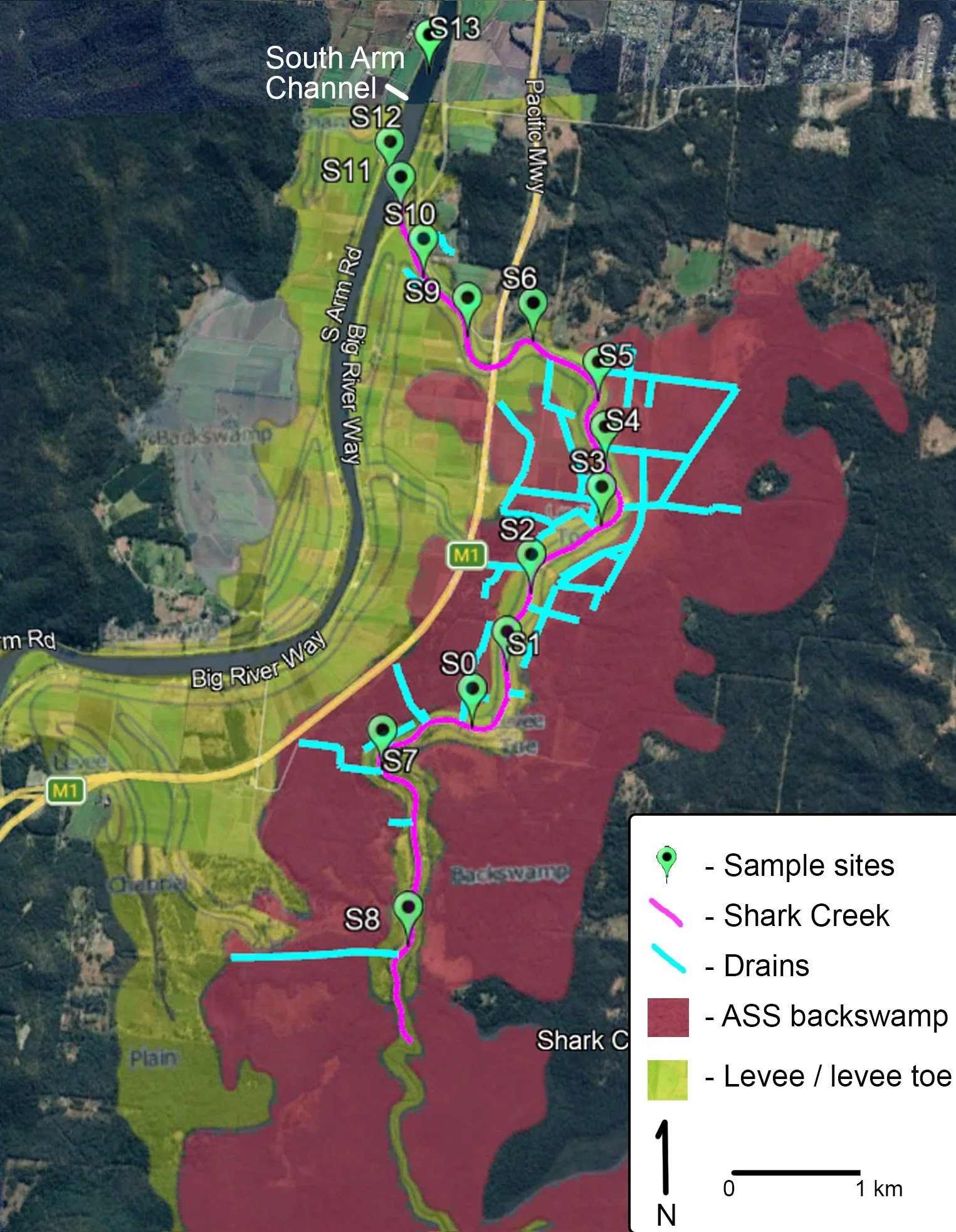
Shark Creek survey site locations, drains, natural levee / toe and acid sulfate soil backswamps.