Where are we monitoring?
Our trained Freshwater Volunteer Team are monitoring water quality and collecting water samples at:
Lilydale (main Clarence Channel)
Jackagery (Mann / Nymboida)
Bawden Bridge (Orara)
The sites have been strategically selected to provide best possible overall catchment coverage (given resource constraints). Sampling occurs ~weekly.
Click on the adjacent map to visit the interactive dashboard check out the latest data.
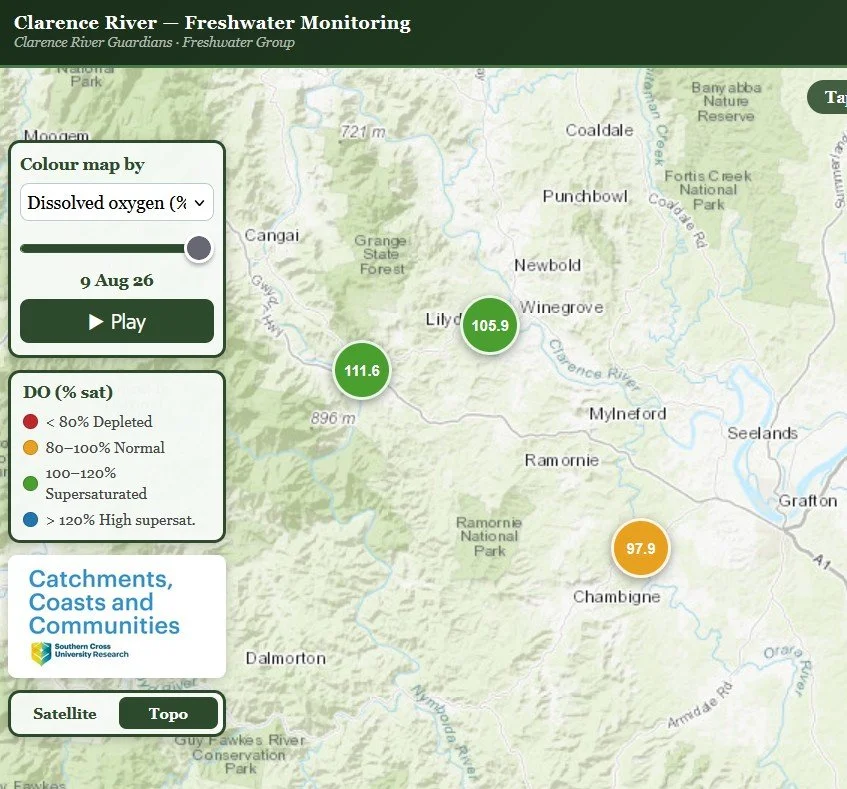
Freshwater water quality monitoring locations in the Clarence - link to interactive dashboard.
What are we monitoring?
At each freshwater site, our water quality meter records six parameters on every sampling run, including temperature, dissolved oxygen (both as % saturation and mg/L), pH, electrical conductivity and turbidity. Together, these give a well-rounded snapshot of stream health — from how much oxygen is available for fish and aquatic insects, to how the water is responding to rainfall, runoff, and the seasons.
Why each one matters:
Temperature — sets the pace for aquatic life, from egg development to how much oxygen the water can hold.
Dissolved oxygen (% sat & mg/L) — the single biggest factor in whether fish, macroinvertebrates, and other aquatic life can survive in a given stretch of water.
pH — tells us how acidic or alkaline the water is, which affects everything from fish gills to nutrient availability.
Conductivity — a quick indicator of how much salt and dissolved mineral content is in the water, often linked to runoff or geology.
Turbidity — measures water clarity, which affects light for plants and can signal erosion or sediment disturbance upstream.
Additional parameters to come:
Volunteers are also trained to collect and preserve water samples for laboratory analysis. Lab analysis of water samples costs considerably more than a field meter reading, so these additional parameters are planned only for our three freshwater sites (e.g. Lilydale, Jackadgery, and Bawden Bridge).
Dissolved inorganic nutrients (nitrate, ammonium, phosphate) — tracks the nutrients that fuel plant and algal growth, with too much often pointing to fertiliser runoff or wastewater input.
Total suspended solids (TSS) — measures the actual weight of particles suspended in the water, complementing turbidity with a hard number for sediment loads.
Major cations / anions — profiles the water's core chemistry (like sodium, calcium, chloride, and sulfate), helping distinguish natural geology from human influence.
Dissolved trace metals — checks for metals at low concentrations, which may signal soil disturbance, bushfire effects or other legacy impacts.
Alkalinity — reflects the water's natural buffering capacity, i.e. its ability to resist sudden swings in pH
All analysis will be conducted at Southern Cross University.